|
February 2012---Training with Good Flying Quail Training with good flying quail increases a bird dog’s prey drive. Good bird dogs love challenges. They are predators, and the more challenging the game, the more excited the dog. I was reminded of this a few years back while I was working dogs on some johnny house quail that had become quite tame. About ten birds had decided not to recall and formed a covey nearby. I was working a little female and watched her go into the woods and point this covey. Head and tail held high, she looked better on point than I had recently seen her. Her whole body quivered with intensity as I stepped in front of her and the birds burst out of the woods like fireworks. This experience reminded me that boring birds make boring dogs. Besides increasing your dog’s intensity on point, good flying quail teach dogs how close they can get without making them fly. The best wild bird dogs are aggressive on their game moving up fast on a covey to pin them before they can escape. There is no puttering around. Cautious dogs, unsure how close to get, rarely have wild birds pointed in front of them because these birds were able to run off. One way to look at bird hunting is a stand-off between the dog and the bird. The bird is trying to escape undetected, and the dog is trying to get as close as possible without flushing it. Poor flying birds allow the dog to crowd them. Few things in dog training are as frustrating as birds that will not fly when the dog creeps closer and closer. The first step to training with good flying quail is buying good flying quail. Try to buy quail from experienced game bird breeders that raise and sell a lot of birds. These birds should be conditioned in flight pens. Some breeders use water misters to spray the birds daily causing them to produce more oil for their feathers which helps them survive when released. Some breeders raise birds in isolation that never see people. They are fed with automatic feeders or at night when workers wear headlamps. Birds raised in isolation become very spooky and flush if you or your dog gets too close. Finding a good source for quail will help you in training and is definitely worth driving a few extra hours for them or paying a bit more. The second step is releasing quail in as natural a way as possible. Releasing birds in the fall and feeding them through the winter is almost as good as training on wild birds, but few people have the resources to do this. Johnny houses can be a good option if you own or lease your grounds. If you train on public grounds, there are some other options. You can put ten or twenty birds in a box, open the box, and let them fly out. While a natural way to train, it can get expensive. Another option is to plant birds for your dog. Planting birds gives you maximum control since you have a good idea where birds are located, but the downside is you leave tracks your dog can follow. To plant quail as naturally as possible, dizzy birds and toss them down in light cover. Try spreading a little wild bird seed and plant two birds together to help keep them in the area. Wait a good thirty minutes before working your dog so birds have a chance to move around and your scent trail dissipates. If you put the effort into buying good flying quail and present them in a natural way, your dog will be challenged. And, as he is challenged and his excitement builds, he learns how to handle them and looks better on his game.
January 2012---Work Ethic Work ethic is a phrase rarely discussed in regards to pointing dogs. The first time I heard the phrase was during an interview I did with a horseback pro-trainer. I asked him what he looked for in a field trial dog, and he said he looked for a dog with a good work ethic. I had never heard this phrase used in reference to pointing dogs, and it took me a while to understand the phrase and eventually see it in my dogs. Dogs are bred for a purpose. In order to define work ethic, we must first look at the type of work the dog is bred to do. For example, herding dogs are bred with an instinct to herd livestock such as sheep or cattle in a variety of situations. The good ones are highly intelligent athletes that are able to anticipate as well as control movements of even the most difficult animals. Comparing herding dogs to pointing dogs is like comparing apples to oranges. We have to look at the purpose for the breed before we can judge the dog’s work ethic. Pointing breeds are bred to hunt birds. To be a good hunter, a pointing dog must have the desire to hunt and not quit. This desire to hunt is how their work ethic is judged. I remember Bill Gibbons was asked for his thoughts on the three-hour National Championship at Ames Plantation during a seminar in South Carolina. Bill said dogs that were still hunting at the end of three hours demonstrated an intense desire to hunt thus proving they should be bred. I asked Maurice Lindley what he thought about work ethic, and he replied, “Good bird dogs are born with it. The more desire they have to hunt, the easier they are to train. Dogs without it are fine until you start asking more of them, and then they decide it isn’t fun anymore and quit.” I knew what Maurice was talking about. I have owned dogs that were always up for training. It did not matter what happened yesterday or last week, they were always ready to go. I could make training mistakes, even put too much pressure on them, and they were still ready to give one-hundred percent when I took them to the field. Sometimes, these dogs were more challenging to train, but they ended up going through the program faster. The desire to hunt was so strong they did not need time off. On the other hand, I have owned dogs that lacked work ethic and needed to be constantly coddled or built up. Work ethic is rarely discussed and often overlooked by pointing dog breeders and owners. Most hunters and field trialers look for dogs that are bred with strong pointing instinct and natural ability, good temperaments, pleasing confirmation and style, but what good are these qualities if our dog is a quitter. Maybe it is time to add work ethic to our list of qualities to look for in a pointing dog. Dogs with good work ethics do not run hot and cold at field trials or when bird hunting, and there is never any guess work about what they are going to do because they give one-hundred percent. Now, some things can interfere with work ethic such as over-training or major training mistakes, but if we have done a good job training our dog and he has a solid foundation, we will see a huge difference between a dog with a good work ethic and one without it. Once we train one with a good work ethic, we never want to go back.
December 2011---Using the Wind Bird dogs use the wind to hunt and find birds. Hunters use the wind to determine the best approach to birdy objectives, and dog trainers like us use it to help our dogs navigate a variety of bird set-ups. Basically, there are four wind situations: upwind, downwind, crosswind, and no wind. Scent is carried on water molecules in the air and moves with the wind. If a dog is running upwind of birds, the wind is at his back and he cannot smell them. If he is running downwind of birds so he is working into the wind, their scent is carried to him. If he is running crosswind to birds so he is at right angles to the wind, he runs across their scent. Most good bird dogs try to run at right angles to the wind so they can hunt a larger area. Having a good understanding of the wind is key to having success in the field. A bird dog demonstrates he is hunting when he uses the wind. Watch the dog run. If he runs on the downwind side of a tree line, he has positioned himself at right angles to any bird scent that might be there. Run him through a field into the wind, and he naturally quarters the field to stay at right angles to the wind. Hunters plan their approaches using the wind. When heading to their favorite grouse coverts, they try to approach birdy objectives from the downwind side. If they approach from the upwind side, birds can hear them coming and have time to escape before dogs detect them. Hunting singles after a covey of quail flush can be as simple as a downwind approach so the dog quarters. It does not take long before the dog becomes skilled at the singles game. Dog trainers have to be constantly aware of the wind when planting birds or bringing the dog into different bird set-ups. We leave foot tracks every time we plant birds. Four-wheeler tracks too. Try coming in from the upwind side when you walk or drive a four-wheeler to plant birds so you leave as few clues as possible for the dog to follow. Once you bring the dog to the field, try approaching birds so the dog is crosswind to them. This way, he runs across their scent and immediately gets a nose full. If you approach from downwind of birds, their scent builds as the dog gets closer, which may encourage him to creep. The wind can be a fickle partner often dying down or changing direction in a short period of time. Be sure to constantly monitor its direction either by feeling for it on your face or tossing a small handful of grass and watching the direction it falls. Sometimes, the wind simply dies, and when this happens, it is smart to have a plan. After you make one or two passes without the dog indicating birds, take the dog on instead of trying to force the situation. If you have another bird planted, work him on it or practice some check-cord work. You can always come back, and maybe the wind has picked up and scenting improves. As you pay attention to the wind, you become more in-tune with nature. And as you become more in-tune with nature, you gain a better understanding of ways in which dogs hunt. Now, you are getting down on the dog’s level and starting to think like a dog.
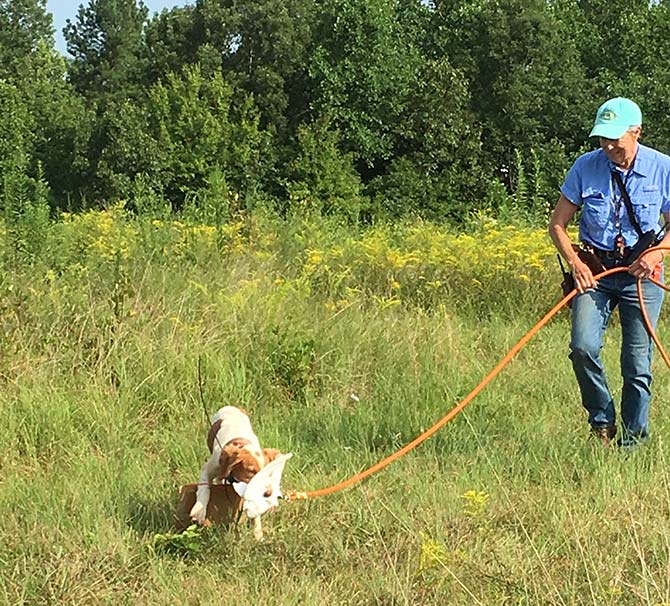
November 2011---Developing Point in a Young Dog It sounds like a contradiction, but the best way to develop a young dog’s point is to let him chase birds. Every time a young dog chases birds, he is learning to point. He is learning his movements cause them to fly, and he cannot catch them. Once he realizes he cannot be successful, he begins to chase less. He becomes more cautious and begins to creep. This creeping is like a cat stalking a mouse, and eventually, he freezes into a point. Last month, a bird hunter came by with his dog. The dog was young, maybe eight months old, and he was concerned she did not point. I loaded a releaser with a homing pigeon and planted it in the training field. I suggested he bring the dog crosswind to the releaser, and as soon as she smelled the bird, I would open the releaser. I explained that when she dove for the bird, he should restrain her just enough so she did not catch it, and then, once the bird was in the air, he should drop the check-cord and let her chase. He said he understood and brought her into the field. As they approached the releaser, she caught scent and turned towards it. As she began to road in, I pressed the button on the transmitter, and the releaser opened. Right then, the hunter tightened up on the check-cord and held the dog tight as the pigeon flew away. I asked him why he stopped her, and he explained he was trying to help her point. Birds teach dogs to point. If you try to help your dog, he will never point birds with intensity much less learn how to handle them. Dogs that have been helped to point by their owners look as if they are indicating the presence of birds instead of freezing in a stance that sends quivers down your spine. In the West method, training is between the dog and the bird. By letting the dog run at birds until he decides to stop chasing on his own, the bird is teaching the dog to point. With a young pup, dropping the check-cord once the bird is in the air and letting him chase as far as he wants to run is fine. You may need to restrain him with the check-cord just enough so he does not catch the bird on the ground before it flies, but once the bird is in the air, you can drop the check-cord. As the pup gets older or when grounds are not suitable to let the dog run free, keep hold of the check-cord and let him chase to the end. Once he is stopped, let him watch the bird fly off. Pointing dogs love to watch birds fly so watching them fly is a reward. A small number of dogs live for the chase, and if, after a reasonable amount of bird exposure, your dog continues to chase without becoming stauncher on point, you may want to keep hold of the check-cord to limit his run. Bird dogs are predators. They have better noses and are superior hunters. Good trainers respect their dogs’ natural abilities and allow them to make mistakes so they can learn from them. It is foolish to think you know when to stop a dog around birds. Instead, let your dog run at birds as long as he is not catching them, and eventually, he teaches himself to stop because he realizes it is smarter to stand there, especially when you occasionally shoot a bird for him. Anytime a dog learns something on his own, he learns it better than when you teach it. By respecting your dog’s abilities and setting up training situations where he can learn from the bird, you are developing him the natural way, which is the best way possible.
October 2011---What is a Balanced Dog? Have you ever heard a dog trainer talk about a balanced dog or wondered what this expression meant? The first time I heard the word balance was when a horseback pro-trainer told me my derby dog was not balanced. He explained that he was more mature on his game than on his ground race and kept repeating that a good field trial dog had to be balanced. In an effort to be clearer, he held his right hand above his head to represent the dog’s bird work and his left hand below his hip to represent the dog’s ground race, which he said was reckless. He was correct. The dog did not listen. Then, he held both hands at chest level to indicate where the dog should be. This concept was his idea of a balanced dog, and to be honest, the conversation went over my head, but through the years I have thought a lot about balance and tried to understand it. Since that conversation, I have been on the lookout for other trainers who used this word. When I started following Cesar Milan on the television show, The Dog Whisperer, I noticed he talked a lot about balance. In his recent book, Cesar’s Rules, he described a balanced dog as a dog that is comfortable in its environment and in its own skin. I really liked this description because a good bird dog has to be comfortable in its environment and in its own skin, but it was still hard for me to grasp. I needed a more specific way to think about it. I realized that maybe a balanced dog is simply a dog without weak links. If I thought about a dog as a length of chain, the chain is only as strong as the weakest link. In the West method, we talk a lot about weak links and how they are the weakest part of the dog’s training or a shortcoming or hole the dog has. The pro-trainer who had talked to me about balance twenty years ago was trying to explain that my derby dog was not balanced because he had a weak link—he did not listen. He was trying to tell me I needed to get this dog balanced—paying attention and going with me, before developing his bird work. Finally, I was able to grasp the concept of balance and use this concept to become a better trainer. The first thing I do with a new dog is take him to the field to see if he is balanced. I look for his weak links to tell me what type of training he needs. If he is a pup, I take him for a run and carefully observe him. Some pups may pay too much attention to me or show little interest in hunting. These pups need to find birds to develop prey drive and learn to hunt. Some pups are real independent and care less about where I am. These pups need to learn to pay attention and find birds with me. For a dog that is older or already in training, I take him to the field and study him. His weak links tell me how training is going and what to do next. And as I make these weak links stronger, the whole dog becomes stronger, and before long, I have a balanced dog that is comfortable in his environment and in his own skin.
September 2011---The Tale of Two Pups This summer, I acquired two new pups. Red was a nicely put together female with lots of color. Whitey was a big white male. They came from different breeders and different lines of dogs. Red arrived in June and was 9 weeks old. Whitey arrived in late July and was twelve weeks old. These pups were well-bred and had lots of natural ability, but both had weak links, and their weak links determined how each pup was started. A weak link can refer to the weakest part of a dog’s training, and it can also refer to a shortcoming or hole that the dog has. When I look at pups and how to develop them, I look for their weak links—which links need to be made stronger? Red was a good case in point. The first time I took her for a run, she made tight little circles around my feet and whined to be picked up. This behavior was definitely a weak link. The best thing to do with a pup like this is ignore the behavior and treat it like a nothing. I decided to take her for a run every day until she showed interest in her surroundings. After about a week with no improvement, we headed to the bird pens that included a pigeon loft and two johnny houses. I was curious if she would start using her nose. To be on the safe side, I try not to show birds to a new pup until she is confident on the ground. After another week of circling and whining, she finally dropped her head and sniffed the ground. A little bit later, she picked up a feather and started carrying it in her mouth. A-hah, I thought. She was ready. I got a quail from the johnny house, pulled a couple of wing feathers and held it by the feet so it fluttered. She showed no hesitation and tried to bite the head so I tossed it on the ground. She became totally focused on the bird pouncing on it and chasing it. Eventually, the bird escaped in the cover, but instead of coming to find me, she returned to where the bird had been tossed down and hunted this area hard. I remained quiet, and after a while, I slowly walked away. It was ten minutes before she came looking for me, and after that, she was a different pup. She had discovered her purpose in life, and she had discovered her nose. Whitey was a different story. He was bold and very independent. The first time I took him for a walk, he took off, and while he loved to run, it was obvious that he was not hunting. Pups that do not hunt have a weak link and need to learn to use their noses. Independent pups need to find birds with us so they have a reason to go with us, and this was another weak link. I snapped a check-cord to his ID collar and let him drag it so later I could hold on to it to keep him with me. After running him a couple more times dragging the check-cord, I showed him a quail. When I held the bird by its feet and it fluttered, it scared him, but the more the bird fluttered, the more interested he became so I tossed it down. He was definitely unsure and alternated between investigating it and running away. I stayed back and stayed quiet. Whitey did not get the bird in his mouth that day, but after a couple more exposures to quail, he finally dove in and got the bird in his mouth. Once he did that, I picked up the check-cord and used it to keep him with me. He proudly pranced around with his new trophy, and I remained quiet as he walked in front of me carrying the bird. It took him a couple more exposures to quail before everything started to click, and soon, he was hunting as well as paying attention to where I was. Red and Whitey had different weak links. In Red’s case, she had to become aware of her surroundings and focus on something other than me. Whitey was impressive on the ground but he did not hunt or care where I was. Both pups were born with the right tools; they just needed a little help discovering how to use them. By focusing on their weak links, I was able to start them on the road to becoming the bird dogs that they were bred to be.
August 2011---The Steadying Process and Dominant Dogs Fritz was showing all signs of being ready to start the steadying process. He was over a year old and had run at a lot of birds. Whenever I took him afield, he hunted hard to find them. Birds were on his mind, and recently, he had begun holding point longer. I had introduced the e-collar at five-months old, and he handled well and went with me. Recently, I noticed he was acting more dominant around the kennel, but I had not given it much thought. The first time I took Fritz to the training field, I was in for a surprise. I put the pinch-collar, check-cord and e-collar on him and began walking him around the field. He surprised me by acting like a total knot-head and dragging me everywhere. My training buddy laughed and said he had Attention Deficit Disorder, and for sure he acted this way. I had set up a couple of releasers but decided working him on birds was like pouring gasoline on a fire that was already out of control. In Fritz’s case, I knew I was wasting my time trying to do anything with him until he calmed down and started paying attention. Also, it was dawning on me that he had become dominant. In my defense, it is not uncommon for young males to become dominant as they mature. Some can get really full of themselves like teenage boys, and I realized that this coming of age was happening to Fritz and I had missed it. I also realized that I needed to get him calmed down and paying his attention through physical means in order to earn his respect. I did not make much progress in the first session so, in the second session, I placed the pinch-collar above the ID collar. This placement makes the pinch-collar tug more severe, but Fritz was too amped up to care. To teach him to stop pulling and pay attention, I changed direction, said, “Here” and gave a pinch-collar tug that pulled him off-balance. A couple of times when he was in front of me, I stopped and stood still. I put some slack in the check-cord and gave a good backwards tug asking him to come to me, and I asked him to come all the way to me and give me eye contact. Eye contact took some doing, and each time he came in and went past me, I stepped back and tugged again until he finally looked up at me. I continued to turn, tug and ask him to go with me and come to me in each session. If he pulled too hard, I spun him. It took a total of four sessions before the light came on. The change was obvious. His expression said—oh, you here too? Now, he was calmer and I had his attention. I was ready to teach the stand command. Teaching the stand command helps you establish dominance over a dog, and the more dominant the dog, the more important it is to get this message across early in the steadying process. Training a dominant dog takes experience because he may act in a similar way to a dog that does not understand what he is being taught so you have to know what you are looking at. I put out two releasers just in case Fritz surprised me by being cooperative. Once we got to the field and he was working in front of me on the check-cord, I asked him to stop and stand-still. He stopped but he did not want to stand still. I knew I had to be demanding and teach him to keep four feet planted on the ground in order to earn his respect. He put up a good fight to stay in control and challenged me by taking steps or moving whenever I took a step behind or in front of him. We never worked on releasers, and I went three more session before he made enough progress that I showed him a bird. Fritz is an extreme example, but dominant dogs like him are good reminders of how important it is to get dogs calm and paying attention before advancing in the steadying process. Once I earned Fritz’s respect, training went much smoother. Dominant dogs like Fritz may take more time in the beginning and require a heavier hand, but by going slowly and foregoing bird work, I was making an investment that would pay dividends in the future. Instead of training a dog that was a knot-head, I was training a dog that wanted to learn.
July 2011---Understanding the Check-cord Sometimes the more simple the tool, the harder it is to understand. The human mind seems to like making simple things more complicated. Maybe simple is more complicated. Take the check-cord. There are few pieces of training equipment as simple, yet this short piece of rope is the single most important tool you will own, and it is vastly misunderstood. Unlike a leash where the dog walks next to you, a dog should hunt in front of you while walking on the check-cord. In the West method, the length of a proper check-cord is about 12 to 15 feet with a snap at one end. Shorter than that and the dog does not have room to move; longer than that and you have problems handling the rope. If you are right-handed, you hold the check-cord in your right hand and vice-versa. Timing is everything so it is important to use your stronger hand. The rest of the check-cord drags behind you on the ground. You do not carry the extra length in your other hand. It takes practice to get the feel of the rope. Let it slide through your hand to slowly feed more rope to your dog or place one hand over the other to choke-up on the rope and get closer to the snap. The single most important purpose of the check-cord is to control your dog. A few years ago a fellow came by with a young pup that had never been worked on pigeons and asked if his pup could chase some of them. I loaded up a couple of launchers and placed them around the training field. He got his check-cord, hooked it to his pup’s collar, led him to the field and then dropped the check-cord. Before I could react, the pup had run over the first launcher and was heading to the second one. I asked him why he dropped the check-cord, and he said he wanted his pup to run free. Running free is great when birds are loose and can get up, but as soon as you set limits such as limiting the area a dog can hunt, or limiting the bird’s ability to fly, you need to have control of your dog. In this instance, when working a young pup, I use the check-cord to bring him into the area where his approach is crosswind to the launcher and then drop the check-cord once the bird is in the air. He is free to chase the bird, but I control the approach. Once your dog is ready for formal training, you use the pinch-collar and check-cord to teach him the here command and stand command, and you continue to hold the check-cord to stay in control. Your dog should pull as he works in front of you but not pull too hard. It is a fine line. You want a happy dog that pulls with excitement, not a disrespectful dog that drags you around. A disrespectful dog needs to learn to be respectful, and you do this with the check-cord by asking him to go with you and come to you. As your dog becomes more steady, you begin to drop the check-cord. While it may not seem like a big step to you, dropping the check-cord can be a big step for your dog. Often he will chase once he realizes you are not at the other end. Sometimes a dog that has advanced to dragging the check-cord starts making mistakes. You can help set him straight by taking a step backwards in training, picking up the check-cord and holding it for a few sessions. Recently, Maurice Lindley and I were talking about the check-cord and how often new trainers misunderstand it. Maurice went on to explain how much trouble we go to setting up different training situations and said, “I look at the check-cord as the tool that guides the dog into the different training set-ups. We take the time to set up training situations with birds so the dog can learn from the bird. Without the check-cord the training would be really hit and miss, very inconsistent. A good example is bringing a dog into the bird set-up crosswind at a certain distance. Too far away and you cause creeping; too close and you might have the dog right on top of the bird and he catches it. The check-cord is the early guide and critical to this method.” Hopefully, as you become more comfortable with the check-cord and understand how to use it to control your dog, you will see how complex this simple tool really is and why no trainer should be without one.
June 2011---Delayed Chase Delayed chase is when a dog runs in the direction birds fly once the dog has been released from pointing, backing, or stop-to-flush. If you compete in field trials or hunt tests, judges will fault your dog for attempting to pursue birds once they have flushed. Most hunters do not see delayed chase as a problem, and some welcome it especially when a covey flushes and their dogs take off in the direction the birds flew. Heck, it shows intelligence and an ability to mark the birds’ flight, but in competition, a delayed chase may keep your dog out of the ribbons. A good bird dog naturally wants to follow the bird. The best way to teach a dog not to delay chase is to build good habits during formal training. Any time a bird has flushed in front of my dog, I say, “Here” and walk in the opposite direction. Some may prefer using the heel command, but either way the dog learns to go with you after bird work. I do not tap the dog to release him as I would from a stand command. Nor do I use a verbal cue such as “ok” or “alright.” Release commands can get you into trouble around birds. If you are consistent and always give the here command (or heel command) to ask your dog to go with you around birds, he will not learn to delay chase. Over the years I have asked many dog trainers what they look for to determine a dog’s intelligence. Almost unanimously they say a dog that remembers where birds are is an intelligent dog. In the 1990s I had a big going Brittany on the circuit and was visiting the trainer. We ran this Brit. About half-way around we lost him, and it was not long before the trainer took off riding hard. He returned with the dog, and I was in awe that he knew exactly where to look. Later, I learned it was simple. This dog had birds, remembered where they flew and ditched us to go back and find them again. The trainer was not psychic, he used good common sense. He knew the dog and knew to look where the dog last found birds. Last summer I had a three months old pup that I had just started running on foot. The second time out he took off and was about 800 yards on the Garmin. This range floored me until he did it again and I realized he was running from johnny house to johnny house. Even at such a young age he remembered where birds were. Dogs are predators and the better bred they are, the more intelligent and driven they are to find birds. Sometimes their ingenuity surprises us, but it is a good reminder to never underestimate the intelligence of a good bird dog. By anticipating a dog’s natural desire to delay chase, we can use the here command (or heel command) around birds and build good habits early.
May 2011---Advice on Picking a Pup Spring is one of the best times to think about getting a new pup, and it is also the time people start calling me to ask for advice. I give the same advice regardless of whether the person wants a hunting dog or a family companion. I suggest they look for a field-bred pup. A field-bred pup is a pup from field trial lines, and one glance at the pup’s pedigree gives you this information. You want to see one or more champions in a four generation pedigree. Reading a pedigree can be confusing because the two major registries for pointing dogs— the American Kennel Club and Field Dog Stud Book, use different titles to designate a champion in the field. In an AKC pedigree, a field champion has an FC in front of his name while a show champion has a CH in front. In a FDSB pedigree, a winner of an American Field championship has a CH in front of his name so you have to pay close attention to the registry. Look for FC titles in AKC pedigrees and CH titles in FDSB pedigrees to tell you if the pup is from field trial lines. The best bird dogs are bred and not made. It is as simple as that. Natural ability and pointing instinct come from parents, grandparents and so forth. So does health, temperament, intelligence, biddability and trainability. Many bird dog qualities that make a field trial dog successful also make a hunting or family dog successful. Field trailers are a competitive lot, and they want to show up at a trial with a dog that can win. · If the dog is not healthy, he is not going to be able to run an hour. · If his temperament is bad, if he is aggressive towards other dogs or people, he is not going to win either. · Intelligence and a calm mind are big assets in the field. A dog that remains calm in the kennel saves his energy for competition. · A dog that is biddable and wants to work for his handler finishes the hour while the dog that does not care will be lost. · Trainability matters. Pro-trainers talk about high and low maintenance dogs. High maintenance dogs need constant work and retuning. Low maintenance dogs retain training. They may chase a bird on occasion but will point the next one. Successful field trial dogs have proven they have what it takes to be trained to the highest level. Of course, not all field trial litters make good hunting dogs or family companions. Sometimes field trialers try to breed more extreme types of pups because great champions tend to be more extreme. That said, two or three generations removed, field-bred pups become less extreme as laws of nature move them towards the middle, and yet they retain many of these bird dog qualities. If you are looking for a started dog, a dog that is not quite good enough to make it in field trials may be your perfect hunting companion. Often these dogs lack the independence necessary to win, but less independence is an advantage for the foot-hunter. An added plus is these dogs usually have a fair amount of training in them already. So, regardless of what you want to do with your pup, my advice is to consider a field-bred one. Pointing dogs were developed for the purpose of finding and pointing birds, and the qualities that make them successful in the field are the same qualities that make them special in everything else they do for us.
April 2011---Stay Out of the Way If you are following the monthly training tips, you have heard me talk about times in training when I don’t have a clue what to do. A Brittany pro that trained dogs to National Championship wins told me one time that dog training is a guess. The trainer guesses, and the dog’s reactions tell him if he is right. Undoubtedly, the more dogs you have on the end of the check-cord the better you guess. Since I am an amateur and don’t get to train a lot of dogs, I carry a short list of rules in my head to guide me into making better guesses.
These simple rules are part of the West philosophy of dog training. A few years ago I added another one to the list.
Too often as trainers we think we know more than our dogs. I see trainers using the whoa command to tell their dogs when to point. They tell them when to be cautious, where to hunt, and a hundred other things their dogs already know how to do rather than simply letting their dogs learn on their own. Last week I was working my two year old Brittany Max on quail in releasers. I had opened the releaser early and was letting him drag the check-cord as he hunted down the feed strip. When he got about half-way down, he pointed, and then he began to creep. Instead of yelling whoa or nicking him with the e-collar, I stayed back and out of the way. Sure enough, he crept closer to the bird and then pounced big time putting the bird in the air and chasing it. Only after the bird flushed did I take charge and nicked him as he chased. Once he stopped, I went to him and gently but firmly stood him up and walked in front to let him know flushing the bird was my job. The concept of staying out of the dog’s way is appropriate at all different stages of training. Maurice Lindley made a terrific post to the pointingdog board in February where he used the concept of staying out of the way to help a dog that was blinking birds. Here is Maurice’s post:
A famous cutting horse trainer said the secret to training horses was to know what the horse was going to do anyway. The same holds true for training dogs. Getting to know your pointing dog—the intelligence, superior nose and genes behind him—will give you the confidence to stay out of the way and let him learn on his own so he can become the bird dog he was born to be.
March 2011---Flushing Birds for your Dog Last week I was explaining to a training buddy how to flush birds for her dog. As we were talking, I realized that as trainers we were constantly adapting to each situation—both the dog situation and bird situation, and that made for a myriad of flushing situations. Let me give you some examples. Flushing in front of young pups is different than flushing in front of older pups. There is flushing for green-broke dogs verses broke dogs, birds in launchers verses planted birds verses wild birds. How you flush can help your dog or hurt him, and while an entire book could be written on this topic, for now here are a few tips. Try not to flush birds for young pups. If your pup points, wait and see if he is bold enough to flush the bird himself. You want to build boldness in your pup around birds and it begins here. By waiting, you give the bird a chance to move around, and the pup is tempted into getting closer and eventually making it fly. As pups get older and start holding point, do not mess around. Get up there and flush. Also, be careful how you approach the bird. If you walk in alongside your pup, your approach may act as a cue for him to go with you. Instead, make a half-circle around your pup which encourages him to remain standing. Whenever possible, try to position yourself so you are already in front of him so you can flush towards him. Being in front encourages him to hold point and discourages creeping. During the steadying process, you want to do everything you can to encourage your dog to stand still. If you are working with launchers, you do not need to walk all the way to the launcher. Once you are in front of your dog, you can launch the bird. Again, try to avoid walking in alongside him. It is important to act calm whether you feel that way or not. If you are using releasers, you may have to walk farther to make the bird flush. Once your dog becomes steadier, you want to challenge him to remain standing by taking longer to put the bird in the air. Once you move to loose quail, flushing requires more skill. Often you do not know where the bird is located, and you may find yourself longing for the control that launchers/releasers gave you. Making the bird fly becomes a challenge, and sometimes you have to calmly walk a running bird away from your dog, and on occasion throw your hat to make it fly. Probably the biggest challenge at this stage is determining when to walk in front of your dog. A lot of dogs point and then begin to creep. Here is where the art of reading your dog’s intentions is so important. If your dog points but starts to creep as you approach, you may want to step back and see if he continues to creep. If he stops once you step back, he may move forward when you step forward again. Tapping him on the head and asking him to relocate may encourage him to remain standing or, better yet, encourage him to pounce so you get a good correction once the bird is in the air. Murphy’s Law is always at work, and the dog with the problem is usually the dog that has the bad luck bird work. Having good flying quail and planting them in loose cover so they can escape if your dog pressures them are critical for success. Ideally, birds should flush as you walk in. If you have been stomping around and cannot produce a bird, it may make more sense to gently pick-up your dog and carry him back a short distance before taking him on rather than relocating him into a quail that has buried itself in the grass. Picking up your dog may also be called for when the bird allows the dog to get too close. In other words, some situations are better avoided when you know they will likely end in your dog catching the bird. If you have the opportunity to train on wild birds, make a small half-circle in front of your dog and then walk straight forward in the direction he is pointing. You want to be calm but aggressive because these birds may be running. If nothing gets up, birds may be sitting tight. Walk back to your dog and then walk forward again but this time walk more slowly and in a zigzag pattern. Flushing is a difficult skill to learn. It really is more complicated than it appears and takes a lot of experience on your part. If you pay close attention to each situation and try to learn from it, you will help your dog become steady. Dog training is a two-way street. Both you and your dog have to learn so together you can help each other.
February 2011---Before the Workout Taking a little time before the workout begins can help set-up your dog for success in the training field. What exactly am I talking about? Dogs have to be in a submissive state to learn, and there is a short period of time once you arrive at the training field that can be used to help your dog get in the right frame of mind. Let me explain. When I arrive at the training field, I have a routine. The first thing I do is put dogs on a stake-out chain. This stake-out chain restrains their movements and requires them to submit. I get my equipment ready, plant birds, and by the time I return, dogs are focusing on me and eager to go. I get the pinch-collar and check-cord and select a dog to work. I hold the pinch collar in a vertical position in front of the dog’s head as an invitation to put his head through the opening. Right there the dog’s reaction tells me how he is feeling. Some dogs can hardly wait to put their heads through the opening, and I see this reaction as a willingness to learn. Others dogs purposely avoid the opening by dodging their heads from one side of the pinch-collar to the other side. This reaction tells me the dog thinks he is the leader. If he continues to refuse this invitation, I gently nudge him with my knee in a dominant way. Usually a nudge is all it takes for him to comply and put his head through. Next, I unhook him from the chain and walk a short distance before asking him to stop with an upwards tug of the pinch-collar. Once stopped, I straddle him and hold him between my legs to put the e-collar around his neck. Straddling a dog lets him know I am the leader. If you think about it, maybe fifteen minutes have past, and I did three simple things before the workout began to help the dog get in the right frame of mind. First, I put him on the stake-out chain. A crate also works because it confines the dog and requires him to submit. Second, I asked him to put his head through the pinch-collar. Third, I straddled him to put on the e-collar. All three actions let him know that I was the leader. While these actions may seem minor, in the dog’s world, once he becomes the follower, he is ready to learn. The next time you train with a pro-trainer, pay close attention to his routine before the workout. Often this routine is so subtle it is easily missed. Pro-trainers have learned, and you will too, that by taking a little time before the workout begins, you can increase the odds for having success in the training field.
January 2011---It’s a Nothing Ever hear the expression—it’s a nothing? Ever wonder what it means and why it is an important part of dog training? Basically a nothing is something a dog does that you chose to ignore. In other words, you do not correct him and you do not praise him. You act as if it never happened. I first heard the term used by Dave Walker in the early 1990s. Dave had flown to Pennsylvania to do a seminar for us. After the seminar, Dave and I kicked back and were relaxing in a couple of chairs. I had an eight weeks old pup with me. He had found a dead quail and was lying under the table eating it. Feeling a little self-conscious about what to do, I glanced at Dave and he was watching the pup too. “So what would you do,” I asked, pointing at the pup. “Nothing”, he replied. “It’s a nothing.” Dave went on to explain that if I took the bird away from the pup, the pup would remember, and next time he might be less willing to bring me a bird. On the other hand, if I praised him, I was sending him a message that would be a contradiction once the steadying process began. By treating it as a nothing and ignoring him, I kept myself from being involved and sending the pup mixed messages. Over the years I have thought a lot about this exchange, and the concept of a nothing continues to help me in training. Just the other day one of my training buddies missed a correction. She felt badly and asked me what she should do. I told her to treat it like a nothing which is just what she did. She did not dwell on it. Instead, she ignored what her dog had done and was able to move to the next set-up quickly and get her dog back on track. Maurice Lindley trained with Bill West and I asked Maurice if he was familiar with nothings. He said he knew all about them. “I think it takes people a long time to understand that most stuff is not that important. If a little mistake happens, they worry they are ruining their dogs. Bill West said that most people think if a dog catches a bird, it will set back them back thirty days. Bill said it set him back one workout, maybe two.” So many times things happen in training that we cannot control. There are missed corrections, unusual situations, as well as times when we simply do not have a clue what to do. By treating these things as nothings, we do not make a big deal out of them. We do not get upset or try to correct or praise the dog. By ignoring what the dog did, we can move to the next set-up and the dog will most likely be fine. To quote Maurice again, “Training dogs is so much nicer when you can relax.”
December Tip 2010---Creeping One of the hardest aspects of training pointing dogs is gaining the ability to read the dog. It is almost like you have to think like a doctor diagnosing a patient. You do not want to be distracted by symptoms; rather you want to figure out the problem. A great example is a dog that establishes point and then begins to creep. Many trainers correct the dog for creeping. However, creeping is a symptom. The real problem is the dog still wants to chase the bird. Maurice Lindley sums up the situation this way: “Most people start correcting the dog for creeping which is wrong. The correction should be for chasing. Once the chase is gone, creeping is not an issue.” I have been steadying two young dogs on quail in releasers this fall after foundation work on pigeons. Each dog is handling quail differently. The male points the releaser, and when I flush the bird, he sometimes chases like a puppy. Dogs like him are easy to work because anytime he chases, I use the e-collar to take away the chase. The female is a different story. She points and then starts to creep. If I take a step, she takes a step. If I tap her to move up, she won’t move. Trying to stop this type of creeping will have you pulling your hair out. The only way to really fix the problem is to set up a situation where the dog chases. You need good flying quail that get up when pressured by the dog. I found some ragweed cover in my training field that was open enough that birds could run but high enough that they stayed in the area. I tossed down a couple of dizzied birds and waited about 30 minutes. When I brought the female into the area she made game. She knew birds were running and it got her excited. She knocked two birds in a row chasing both, and I corrected her with the e-collar. It will take a few more corrections to get her right but by focusing on the problem—chasing, and ignoring the symptoms—creeping, I am well on my way to having a stylish little bird dog that makes me proud.
November Tip 2010---Using Dog Psychology in the Field In October I wrote about using dog psychology around the house and kennel. This month I want to talk about using dog psychology in the field. Dog psychology is relating to dogs the way they relate to each other. In the West method, you use a pinch-collar and check-cord and the stand command to earn your dog’s respect and establish yourself as leader. This training is not obedience; it is dog psychology. Once your dog respects you, you become dominant. You become the leader. Your dog becomes the follower, and because he is in a submissive state, he is ready to learn. His mind is open and he is willing to take direction from you. The first step in formal training is having your dog hunting in front of you on the end of the check-cord. He should pull on the check-cord just enough to show his enthusiasm but not so much that he pulls your arms off. Think about it. If your dog is dragging you around the field, which one of you is in charge? He is. Most good bird dogs start off dragging you around the field. To help you gain control of your dog and put you in charge, there are a couple of exercises you can do. For example, when your dog pulls on the check-cord, try turning in a new direction and give a quick sideways tug which pulls him off balance and makes him go with you. Use the least amount of force necessary to get the job done. When he begins to pull again, change direction and give another sideways tug. Repeat until he starts paying attention to you and where you are going. Another exercise to try is letting your dog get to the end of the check-cord, stand still and give one good backwards tug. You are asking him to come to you. Some dogs come towards you, but when they get close, they pass by ignoring you. Your dog should acknowledge you with eye contact when he comes to you. Continue to use backward tugs until he comes in and gives you eye contact. The stand command is the foundation of the West method. Maurice Lindley calls it “the glue that holds different training steps together.” To teach the stand command, ask your dog to stop with an upwards tug on the pinch-collar. For additional information on teaching this command, see the book, Training with Mo. When this command is taught properly, your dog stops and stands calmly as you walk around him and in front of him. When I first began using the West method, I thought the stand command was about getting a dog accustomed to someone walking in front of him and flushing birds. Now, I see this command as dog psychology. It establishes you as dominant. Not only do you claim the space in front of your dog, but as he learns to stand calmly, he becomes the follower and you become the leader. As you teach the stand command, your dog may be jacked-up and want to move his feet, or he may take steps as you try to walk in front of him. He is letting you know that he is still in charge. He should stand calmly with four feet planted on the ground before you begin steadying him on birds. If you advance too quickly, you will struggle with him throughout the steadying process, and he will challenge you for birds when you walk in to flush. As training progresses, there will be many times when your dog tries to take charge again. Reviewing the stand command or regaining control with the pinch-collar and check-cord between birds are important ways to stay in charge. The steadying process takes as long as it takes, but, if you are patient and use dog psychology, you will discover the pleasure of training a dog that wants to learn and take direction from you.
October Tip 2010---Using Dog Psychology around the House and Kennel When Bill West was asked about his training method, he said, “It is dog psychology.” When Cesar Milan was asked about his training method, he said, “It is dog psychology.” What is dog psychology? Simply put, it is working with the dog’s mind and his mental or behavior characteristics. When you use dog psychology, you are relating to dogs the way they relate to each other or as Dave Walker liked to say, “You are getting down on the dog’s level.” Dogs are pack animals and they relate to others—both dogs and humans, as either dominant or submissive to them. Bottom line is for your dog to respect you he must see you as dominant. Once you earn his respect, he becomes the follower and you become leader. Exercising dominance over your dog is not about being mean to your dog or your dog being fearful of you. Dominance is about leadership and maintaining balance in the pack. Bill and Cesar understood that before training can begin you must first gain the dog’s respect and establish yourself as leader. In the West method, the check-cord is used in formal training to gain the dog’s respect in the field. But even before formal training begins, you can establish yourself as leader by following some simple exercises that Cesar does around the house and kennel. “Claiming” things is one important way dogs establish dominance. Dogs claim things all the time. Ever watch a puppy make a wide circle around an older dog? The older dog is claiming the space around himself. Ever watch a puppy start to go thru a doorway and then let the older dog go first? The older dog has claimed the doorway. How about watching a dog guard his food or a toy? He is claiming it. As a human you need to claim things around you to become your dog’s leader. For example, if your dog crowds you or jumps up, you need to claim the space around you. If your dog charges thru the doorway before you, you need to claim the doorway and walk thru first. Same deal when you open the gate to his kennel. You need to claim the gate and expect him to wait until you give him permission to exit. Ditto with food. Put his food bowl down but claim it before allowing him to eat. It is important to understand that none of these exercises are taught in the traditional sense with commands or treats. These exercises are not obedience. They are dog psychology. You claim things the same way your dog claims things—with energy, and every time you claim something, you are exercising dominance over your dog. How do you claim something? For example, how do you claim a doorway? Here is how I do it. I stand at the doorway and face the dog. Cesar says, “You want to be calm assertive but quietly in control.” As funny as it sounds, I try to imagine myself as a bouncer at a club who silently claims ownership of the entrance. You know the type. He doesn't need to say anything—the energy he projects says it all. If the concept of claiming things is new to you, you may want to read “Cesar’s Way” or tune into the Dog Whisperer on National Geographic Channel. When do you start becoming your dog’s leader? You can get started right away. Here is how I do it. My dogs are kennel dogs so when I get a new dog into the kennel, I begin claiming the doorway, gate, and food. I also claim the space around me so the dog learns not to jump up. With puppies I begin around 6 weeks old. I go slowly taking a couple of weeks to let the new dog or puppies figure out what I’m doing, and before long they are letting me go thru the doorway first. They step back when I open the gate, and they wait for their food. When you learn to claim things and show your dog that you are dominant, he becomes the follower and you become the leader. And once you become the leader, everything you do with your dog around the house, kennel and field becomes enjoyable.
September Tip 2010---Training your Dog to Come to You A good way to get your dog to come to you is to ask him to go with you. You begin when the dog is young. At about 5 months old many pups stop coming to you. It is something that happens in their development and is a normal sign of your pup maturing and becoming independent from his dam. Pups may stop coming to you, but they still have a natural desire to go with you. Let’s say you’ve taken your pup for a run and you want to pick him up. First, try to avoid calling him to you if you think he isn’t going to come. Instead, ask him to go with you. Start walking in a new direction. He doesn’t want to be left behind or miss anything, so when he sees you leaving, he runs to get in front. As he gets close, turn towards him, bend down, and call his name. If your timing is right, he should almost runs into you. Pet him up and let him know how happy you are with him. You are building cooperation. As your pup matures there may come a time when he no longer wants to go with you. At this stage, you need to stop running him until you introduce the e-collar so you can stay in control. Once the e-collar has been introduced, try to avoid using it to make him come to you. Anyone can make a dog come to them with enough stimulation but the dog will never be happy about it. Instead, ask him to go with you. Use stimulation if necessary to ask him to come around, and as he runs to catch-up, turn, bend down and call him. You will find him becoming more and more cooperative, and eventually you will be able to call him to you and he will come running. By going slowly and working with your dog’s natural desires you are building cooperation, and you and your dog are becoming a team.
August Tip 2010---Keeping Your Dog Calm The calmer you keep your dog during training the less intensity is required to train him. Intensity refers to the level of pressure you need and includes how hard you tug with the check-cord and how much stimulation you use with the e-collar. The more excited the dog the higher the intensity needs to be. The calmer the dog, the better he pays attention and the less intensity you need to use. In the West method of training, we try to keep the dog calm so the intensity of tugs and nicks stay low. For example, if your dog gets amped up after working on a launcher, you can work him on the stand command to get him calmed down before going to the next bird set-up. While we talk about tugs and nicks as cues, more importantly they can act to change the dog's focus. A properly timed tug or nick will distract a dog just enough and lower his excitement level before it escalates. Dogs are like kids. They need to be taught while sitting at their desks and not when they are running around the playground. Taking time to keep your dog in the right frame of mind goes a long way to having a happy dog in training.
July Tip 2010---Reading Your Dog Do you pay attention to your dog during formal training? Do you look at your dog's body language for clues to understand what is going on with him? Learning to read your dog will make you a better trainer. For example, do you notice your dog's tail? If the tail is tucked, something may be bothering him. His tail should be up and happy. Do you notice if he is pulling on the check-cord? While you don't want him dragging you through the field, you want him pulling enough to show his enthusiasm during training. Sometimes you may find yourself in situations where your dog points but you are unsure if he has scent of the bird. If he doesn't have scent and you walk in to flush, you are rewarding him for false-pointing and he will false-point more often. By paying attention to your dog, you can learn to read him and tell if he has scent or not. For example, does he move his head when you start to walk in front? Some dogs will turn their heads when they don't have scent. What about the mouth? A dog will usually close the mouth when he has scent. The lips tighten and sometimes the cheeks puff in and out. Pro-trainers call this "smoking a pipe." These clues are just some of the small things you may notice to help you read your dog. Every dog is different and if you pay attention to the small things when you train, you will build a bond with your dog that is as powerful as any force in nature. You and your dog are a team.
June Tip 2010---Knowing When Not to Train As many of you begin summer training and teaching young dogs to be steady-to-wing-and-shot, try to remember that knowing when NOT to train is as important as knowing when to train. If conditions are not good, training will almost always go south, and instead of progressing, you will find that both you and your dog are going backwards. What constitutes good conditions? Good conditions are all about scent. For example, you want at least a light breeze so scent is carried in the air horizontally and not vertically. Even more important, you want to train when the ground is dry. Wet ground holds scent and if you train your dog on wet ground, he learns to drop his head and trail whatever scent is there including your footsteps. A pointing dog should learn to work scent with his head up and the best way for him to learn is to avoid conditions where he is rewarded for dropping his head. As tempting as it may be to train early in the morning, if dew is on the ground, your dog is going to learn bad habits. It takes a lot of discipline to train a pointing dog, and making the commitment to get out there three times a week is a big deal. Be patient and make sure your time counts. If you wait for good conditions, you and your dog will enjoy your time afield. |
|
Piney Run Kennel
|