|
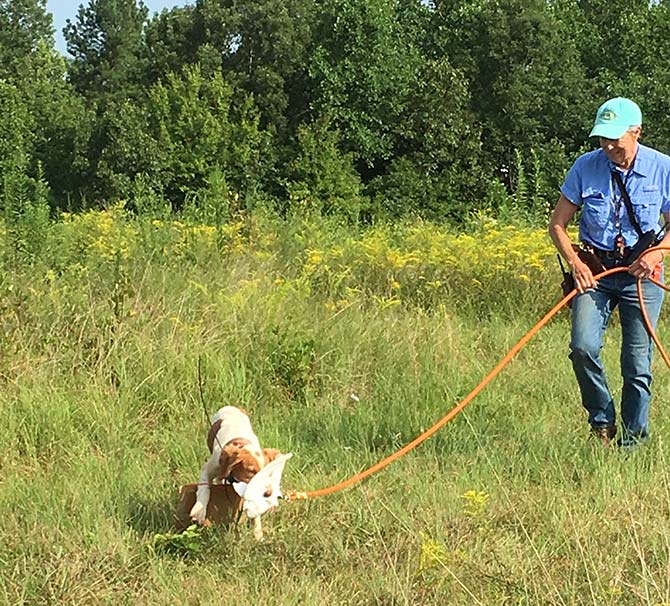
STARTING PUPPIES An Interview with Maurice Lindley By Martha H. Greenlee © Pro-trainer Maurice Lindley always has puppies running around his kennel in Piedmont, S.C. All kinds of puppies---pointers, vizslas, Brittanys, setters, shorthairs. They come from litters he’s bred or from clients that bring them for a day of fun or leave them with him to start. These puppies may be little but they carry big hopes and dreams of their owners. National champions? Brag dogs? At this young age all things are possible. The plan was to visit Maurice for a couple of days in August and talk about training dogs. I also intended to bring along an eight weeks old pup. I could hardly wait to sit down and talk with Maurice about “what and what not to do” to best prepare a pup for formal training. After 30 years of working pointing dogs, I was sure Maurice knew some of the best ways to start puppies. Martha: When do you start a pup? Maurice: If the pups are born here, I normally toss a dead quail in the X-pen with the whole litter around 7 or eight weeks. This fires them up and gives them a chance to learn the bird won’t hurt them. About the same time I start walking them as a group in the field. I want them to get use to the area before I put out birds. When they get three months old, I start exposing them to planted birds. I use quail but not Johnny house quail. I want birds that are spooky that dogs haven’t worked before. I plant a couple of birds where they are easy to find. I don’t try to teach little puppies anything—I want to imprint birds and hunting early on and get them excited. If they point, that’s great. If they find birds and chase them, or if they find them and watch them fly off, that’s fine. I want a puppy to come along at his own pace. A lot of people make mistakes working their puppies on too many birds. What works best is to have only one or two birds out. If a puppy points a bird, I don’t run up and flush it. I just stand back and observe. I stand there and let the puppy stand there on point. Then, all of a sudden, the puppy may want to get a little closer. Maybe the bird’s running a bit, and I’ll see the puppy start trying to figure out things. Maybe he sees something move, and he jumps in, and the bird gets up, and the puppy chases. I use good flying birds, so the puppy can’t catch the bird, but if it happens, it’s really not a big deal, more of a non-event. I pet the puppy, take the bird away, and go on. Martha: What are you looking for in a pup? Maurice: I want to see puppies that get excited when I turn them loose and puppies that go out and look for birds. At first, I may have to walk them around before they find birds. I’ll go with the puppies and don’t do a lot of change of direction, so they learn I’m going to stay in contact with them. This builds confidence. After two or three times exposing them to birds, a puppy should be thinking about birds. He’s thinking—oh, I’m out here again and I’m going to find birds! That’s where the hunting part starts. When they start doing that, I quit helping them. I just stand around and let them find birds on their own. Now it’s real important not to overdo bird exposure. By four months old, they get bird exposure once a week. They might get walked in the field three days a week, but I put out birds one day a week. I don’t want finding birds to seem too easy. Martha: I just have one puppy. Would I train him differently than if I had the whole litter? Maurice: No. If I have one puppy, I’ll work him the same way as a group of puppies. Say I get a puppy to start for a customer. I won’t put birds out for a time or two. I’ll get the puppy used to the new environment before I put out a couple of birds. Martha: I know you said you don’t use Johnny house birds. Are some birds better than others? Maurice: I want the best flying birds I can find because that’s what puts point in the puppy. That’s what develops the puppy in a natural way. He learns that when he smells the bird he better stand there and point. When he moves a little closer—boom, that bird is up and gone. He learns to respect the bird. When the puppy is little, he’s not strong enough to run a good flying bird down and catch it, so I like to expose him to birds early on before he gets some legs under him. I don’t want him to learn he can catch a bunch of birds. Martha: When do you introduce the check-cord? Maurice: Around five months old, I start snapping the check-cord to the puppy’s ID collar. I’m going to let him drag the check-cord to get him used to it because the check-cord is a big part of what I’ll use to train him. Every time I take him out of the kennel or dog trailer, I put on the check-cord and walk him to the field. I stop him real easy—I don’t fight with him, and get him to be still for a second or two. Then I’ll tap him to release him. That’s the beginning stage of teaching a dog to stop and stand still. I can teach a puppy so much just by exposure. Before long that puppy learns he has to stop and stand still before I release him. When a puppy gets real bold hunting and chasing birds, I’m going to introduce the gun. Martha: How do you introduce gunfire? Maurice: As soon as the puppy is bold and chasing birds, he’s telling me he’s ready for the gun. I want to see him intent and focused on getting the bird. If he’s not giving me that type of focus, I’ll wait. Some puppies are ready as young as four months. Some puppies it’s better to wait until they’re five or six months. I really pay attention to the puppy when I fire the gun. I go right ahead and start with a 209 primer gun—I don’t start with a light blank gun. I’m careful and watch his reaction. If he shows a negative reaction like stopping or turning his head when he hears the shot, I lay him up for a week or so before firing over him again. If he doesn’t show a reaction on the first bird, I work him on a second bird, but this time I don’t fire. Say I put out two birds in the training field. He chases the first bird, and I shoot. I shoot pretty quick. He ignores it and keeps on chasing. Say he went 30 yards when he heard the gun on the first bird. Now I work him on the second bird. When he chases the second bird, I watch what he does. If the gun bothered him on the first bird, he’ll let me know right there. He’ll sort-of peel off at 30 yards. If I shoot about the time he peels off, I’m getting ready to build myself a problem. I get lots of dogs in every year to work that are gun shy. It’s a problem I wouldn’t have to solve if gun preparation work was done right. That’s why it’s so important to pay attention to the puppy. Martha: When do you introduce the e-collar? Maurice: Around six months old, most puppies stop listening and get hard to catch at the end of a run. When a puppy stops handling, I stop running him. If he’s mature enough, I’ll go ahead and introduce the e-collar, but if he’s not ready, I’ll wait. Either way I stop running him. I don’t want him to get away with bad habits or become disobedient. When I introduce the e-collar, I begin by teaching him to go with me and come to me with the pinch collar and check-cord in the field. I don’t work him around birds. This training is different than formal training. I’m just teaching him to pay attention to me, and I want him to learn he can’t run off and leave me. I want him to feel he’s part of the team. To introduce the e-collar, I’m going to put it around the puppy’s neck, but I’m not going to use it at first. I’m going to walk him around the field with the pinch collar and check-cord, and when we get out there a ways, I’m going to turn my body, say, “Here,” and tug on the check-cord. As soon as he starts going with me and coming to me on the check-cord, I introduce the e-collar. I’ll say, “Here” and use real low stimulation at the same time I tug on the check-cord. I want him to react by looking at me. I don’t want to spook him. I’m using the stimulation to teach him to pay attention. Once he is paying attention, I’ll start developing his pattern depending on if he’s a hunting dog or field trial dog. Martha: When do you stop working the pup on planted quail? Maurice: Around eight to nine months old, the puppy is physically strong enough to catch birds. As soon as he can chase a bird down, I quit working him on pen-raised quail. I don’t want him making a ton of mistakes that I have to overcome when I start breaking him. I’m not worried about losing any “bird dog”—I already imprinted birds and hunting. I may still expose him to birds, but only if I have full-grown flight-conditioned chukar, Hungarian partridge, or wild birds. He needs time to mature until he is physically and mentally ready to start formal training at around one to one-and-a-half years old. Martha: Is it ok to take the pup hunting? Maurice: This is a good time to take the puppy hunting. Hunting makes a bird dog, and I haven’t started to break him yet. He doesn’t have to be perfect. If he’ll let me get close before helping me flush, I’m going to try to shoot the bird for him, but I’m not going to shoot bumped birds or birds he runs over. I want to show him the big picture—he points the bird, and boss man comes up there and gets him the bird. Getting the bird in his mouth shows him there’s more to it than pointing and watching birds fly off. If I go to a shooting preserve, I’ll try to hunt a puppy on chukar or Hungarian partridge. Ten good bird contacts are plenty for half-a-day. I don’t need to kill a lot of birds, but the first season can be very productive hunting for a puppy. Martha: Any words of wisdom? Maurice: Enjoy your pup, but realize that every time you take your pup out, some type of training is going on. He can learn some real good habits, but he can learn some real bad habits too. |
|
Piney Run Kennel
|