Piney Run Kennel

2180 Hutcheson Rd.

Baskerville, VA 23915

434-774-2763


Home
Puppies
Started Dogs
Guarantees
Books and Articles
Seminars
Training Aids
Training Tips
Links
About Us

JUDGING PUPPY STAKES

By

Martha H. Greenlee©

    “Howdy,” Bobby White said when I walked in the clubhouse at Hoffman, NC.  It was 7 o’clock in the morning.  I had seen Bobby White’s picture in the Field enough times so I recognized him.  He was sitting near the oil heater at a long gray table drinking coffee from a Styrofoam cup and talking to the field trial secretary for Tarheel Brittany Club’s January trial.  Bobby was small and wiry and looked older than his seventy-five years.  He stood up and shook my hand.

    “I understand we’re judging a puppy stake together,” he said.   

    “Yes,” I replied, “Nice to meet you.”

    That was an understatement.  I had been really excited when I found out that I was judging with Bobby White.  He had bred some of the top pointers in the south, and I was hoping he would give me a lesson in what he looked for in a puppy.

    Many field trialers including me believe puppy stakes are the most subjective stakes to judge because you are judging potential.  It is not about what you see in front of you so much as what you imagine that puppy will become.  And then there is the business of personal preference.  Some judges look for all-age potential while other judges look for the puppy they want to take home.  Bobby White had a very successful breeding program so it was obvious that he knew how to evaluate puppies.

    The secretary gave us our judges’ books and told us the puppy stake was breaking away from behind the barn at 8 o’clock.  We parted ways to saddle our horses and met again at the breakaway a few minutes before handlers brought their puppies to the line.  I asked Bobby if he judged many puppy stakes.

    “I judge my own pups every time I take them out,” he said with a grin, “but I don’t get to judge many puppy stakes.  They don’t run pups much in American Field.  I don’t care if it’s a Brittany or a pointer pup, I’m looking for the same thing.  I’m looking for a future champion.”

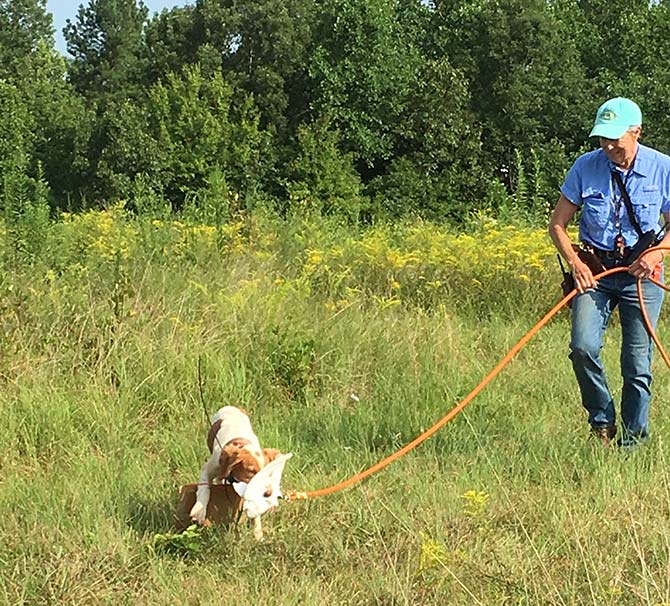
    Bobby asked handlers if they were ready, and we checked our watches.  Bobby had top dog which was a small orange female, and I had bottom dog which was a big roan male.  Both puppies raced down the path almost out of sight.  Just before they disappeared I saw the roan puppy break off to the left.

    “Watch that pup,’ Bobby said pointing at the roan one.  “He’s starting to hunt.  See how he’s using the wind.  He’s hunting.  You can’t teach that.  First and foremost a pup has to hunt.”

    The orange female had disappeared over the horizon and was now coming back up the path.  She got to where she could see her handler and took off again. 

    “Man, she’s fast,” I remarked.

    “Yeah,” Bobby said, but she’s not applying herself.  She’s running, but she has no purpose.”

    The roan pup was starting to make some big casts.  He was bold and at times busted through cover without hesitation.  We called time at 20 minutes and waited for handlers to round up their charges.  The roan puppy was coming to his handler and looked real pleased with himself.  The female was still running around and did not want to be caught.

    “Look at that,” Bobby said looking at the roan puppy.  “He wants to run but he also wants to listen.”

    Second brace was wild.  Handlers screamed and yelled as both puppies ran forward, behind, in the woods, everywhere.  At one point Bobby, looking bored, turned to me and said, “Front running dogs are bred.”

    Third brace Bobby had a nicely built orange female, and I had a smaller male.  These puppies raced down the path, and when the female broke off, the male followed tagging her for the next ten minutes.

    “Gotta be careful to determine which pup is at fault,” Bobby remarked.  “Sometimes both pups contribute to the problem.  Sometimes a pup becomes a real good head trailer and is actually keeping in front of the rear pup making him look like the culprit.  See there,” he said pointing.  “The rear pup lost sight of the forward pup, and he’s dropping his head to track her.  He’s the offender not her.”

The female was opening up now that she was by herself, and she was doing a beautiful job covering the ground and staying forward. 

    “Look at her gait,” Bobby said.  “A lot of Brittanys have a choppy gait.  The front end comes up and then the rear end comes up.  Look at her.  Her back stays level.  Man, that’s pretty.  Looks like she’s floating.  She’s put together right to run an hour.”    

Now Bobby pointed at the smaller male.  “See why the female left him in the dust.  He can’t keep up with her because he’s moving like a seesaw.”

    Third brace ran short and hunted laterally.

    Fourth brace got into sand spurs and both puppies quit.

    So far we had the roan puppy first.  He showed desire to hunt as well as run.  The female from third brace was second.  She ran shorter but was real attractive on the ground with a nice forward pattern.

Fifth brace was the last brace.  Bobby had the big liver male, and I had the smaller white female.  The big male was eye-catching with lofty style that was undeniable even at his young age.  Upon being released, both puppies raced to the front and disappeared.  Next time we saw them they had separated and were hunting hard.  The female was light on her feet and soared across the ground with effortless grace.  She was making some big casts to birdy objectives, and each move was determined by the wind, yet she managed to always turn to the front.

    “Look at her,” Bobby said.  “That bitch runs with her nose.  Ain’t that a beautiful sight!  Dogs like her will always find birds.”

    I was having a hard time taking my eyes off the big male.  Where the female was a ballerina, he was a freight train building speed as he ran.  He had a powerful stride that ate up the ground.  He crossed in front of us tail high and cracking.  When Bobby saw that, he laughed and said, “Look at him cracking that little stub.  He sure is pretty and he knows it.”

The male was making big sweeping casts in some fields but having trouble handling other fields. 

    “You notice that,” Bobby asked me?  “He’s all natural.  He’s quartering that field because he don’t want to run into the wind.  That’s ok with me.  I don’t want to see a lot of straight line running in a pup.  I want to see him hunting his way forward.”

We were both watching the male when he made a big move to the front that carried him to the far end of the long field.  We could barely make him out when he skidded to a stop and swelled into a statue.  His handler galloped toward him and a bird lifted.  Then the rest of the covey flushed, and he was in hot pursuit.  We called time.

    “Don’t get much better than that,” Bobby said.  “That’s a future champion right there.”

    I got my book out and wrote down placements.  We used the brace-mate for second and placed the roan dog third.  The female with the attractive gait from the third brace placed fourth.

    We rode in and stopped at Bobby’s trailer.  He dismounted.  I told him I would take the placements to the field trial secretary, and he said he appreciated that since he was a little tired.  He shook my hand again, and I told him how much I had enjoyed it.

    “I saw some nice pups this morning,” Bobby said.  “A lot of people have a hard time evaluating pups because they don’t know what to look for, but it’s common sense.  A pup’s gotta hunt if he’s going to find birds, and he better hunt in front of me not behind me.  He’s gotta be gaited right if he’s going to run an hour.  And he’s gotta have style because if he don’t, I ain’t interested in looking at him.  It’s as simple as that.  Now a good trainer can make a sorry pup into a weekend winner, but I’m looking for a pup that’s bred to be a champion.  Then I don’t have to do a lot of training to make him into something he ain’t.  Heck, you just have to polish the good ones.”


Contact us at: greenlee@touchva.net