|
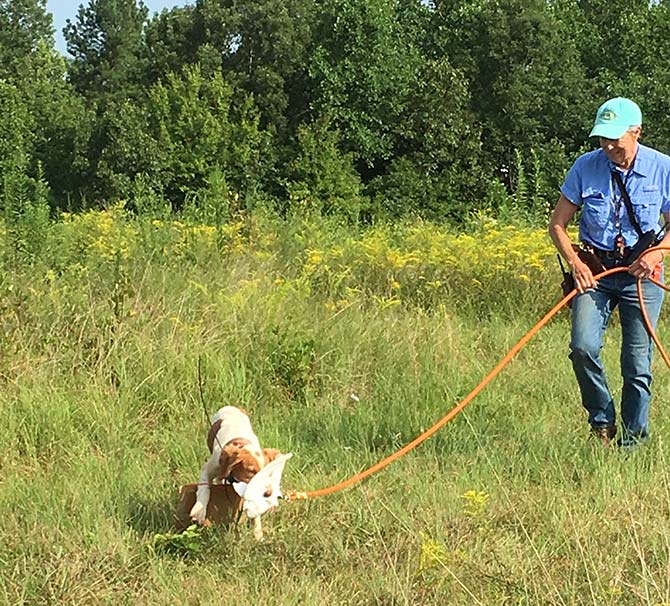
CALM DOGS, CALM TRAINER An Interview with Maurice Lindley By Martha H. Greenlee © I drove to South Carolina to interview pro-trainer Maurice Lindley and watch how he used remote launchers (spring-loaded metal boxes with air holes that launch birds remotely) to teach pointing dogs to be steady-to-wing-and-shot. After three days of training, I drove home and ordered three remote launchers. What I had seen changed the way I wanted to train dogs. Maurice’s dogs were calm. Their heads and tails were up, and they were paying attention as he check-corded them around the four-acres training field. I watched as he took a one-year old pointer that he had been working for a couple of weeks out of the dog trailer and put a pinch collar (leather training collar) and e-collar around his neck. He attached a 12-ft. check-cord to the pinch collar and walked the dog into the four-acre training field. He stopped the pointer up-wind of a remote launcher that was hidden in tall grass. The launcher held a homing pigeon. As the dog stood up-wind of the launcher, Maurice launched the bird. When the dog saw the bird get up, he started to chase, and Maurice stopped him with the check-cord and pinch collar. He was putting pressure on the dog not to chase when the dog did not have scent of the bird. “The way I work with launchers—I don’t let the dog point them every time. I try to keep the dog away from bird scent as much as possible when I’m teaching him to be steady. I’m not making the dog high as a kite and then hammering on him to make him calm. The dog stays calm, and I stay calm. The dog ought to be calmer when you finish your workout than when you start.” Next, Maurice brought the pointer in cross-wind to the second launcher. The dog turned down-wind into the bird and pointed. Maurice stood beside the dog and waited. The dog lifted a foot, and Maurice launched the bird. The dog stood, and Maurice petted him for standing with a couple of long strokes along his back. “Another thing I try to do is use the launchers in a way that the dog thinks the bird is really wild,” Maurice explained. “If I work the launchers right, the dog learns that when he gets real strong scent he needs to stop and stay right there, because if he takes a step, the bird is going to fly. The birds in the launchers are teaching the dog he has to stay at a distance. He learns to respect the bird because, if he takes a step toward it, he is causing the bird to flush.” Maurice tapped the pointer on the head and check-corded him in a different direction. As the dog was moving, Maurice released a pigeon from the third launcher that was up-wind of the dog. The dog stopped at the flush and watched the bird fly off as Maurice petted him. “The great thing about launchers is I’ve got control of the bird. If I want a stop-to-flush, I can set it up. I try to work launchers like carded pigeons (birds with squares of cardboard tied to their legs with yarn). I used to work with carded pigeons, and when the pigeons were wild, I’d get more stop-to-flush work than points. The best work I ever got done with a dog was in a hay field on carded wild pigeons. Many days I’d think—man, I didn’t get anything done. I didn’t get many birds pointed. It seemed like all I was doing was check-cording the dog, and a bird would come up, and I’d stop the dog. But, before long the dog was pointing beautiful, standing, letting me flush, and watching the bird fly away.” Maurice introduces backing once the dog understands that he is to stop at the flight of the bird. He uses a silhouette (a wooden cut-out of a dog on point) with a launcher behind the silhouette. He is careful to bring the dog in up-wind of the bird. Most dogs will stop when they see the silhouette, and when the dog stops, Maurice launches the bird. If the dog notices the silhouette and doesn’t stop, Maurice launches the bird. He continues to work on backing at the same time he is getting the dog steady on launchers. “I try to chain the stop-to-flush work to the backing work. Most dogs start backing pretty quick, once they associate the silhouette with the bird, and they back with style.” So how did Maurice get so smart about teaching dogs to be steady-to-wing-and-shot with launchers in a four-acre training field? Turns out his passion for training dogs began at ten-years old when he and his brother bought their first bird dog. “We saved up $6 and bought an English setter. That’s what started it. Man, I was fascinated by what the dog could do. I fooled with him every day. Then I got a Brittany from my cousin who was a big time wild bird hunter, and I started going hunting with him. I got my second Brittany from him, and through my second Brittany I met Paul Long. I guess you could say he was my first teacher. We became good friends. He talked me into going to my first field trial with that dog, and the dog placed first in the walking shooting dog stake. I started training dogs for a little bit of money at 16. I already had in my mind then that I was going to be a pro-trainer just from hanging out with Paul. He was one of the smartest guys I ever seen for figuring out problem dogs and how to fix stuff. He could look at a dog for a few minutes and figure out what he needed to do with him. “After high school I went to work in a textile mill for 7 years and trained dogs part-time. I had 2nd shift, so I trained dogs every morning. When I was twenty, I started thinking about those trainers going to Canada, and I wanted to do that. Collier Smith hired me for the summer. That was really good experience and a good family to be with. After Canada, I went back to the mill. Eventually, I was making more money working dogs, so I quit the mill and started working full-time with the dogs.” The story doesn’t end here. By the early 1990’s, Maurice was feeling burned out. He was looking for a different way to work dogs, and he heard about Dave Walker. “I was fighting with the dogs. Learning about Dave and that method was a turning point. I brought him to my kennel to teach a couple of seminars, and through Dave I met Bill West and Bill Gibbons, and I brought them in to teach seminars. Meeting Bill West—he was a really big influence. He could explain why he did things.” Maurice began training with carded pigeons as Dave Walker, Bill West, and Bill Gibbons had shown him, but after a couple of years he got tired of the birds hanging-up in the trees that surrounded his property. He needed wide open spaces, which he didn’t have. He thought about using remote launchers (available from gun-dog supply catalogs), but he knew that launchers could create problems. First, some models were noisy when launched, and this noise spooked some dogs. Second, they launched the birds into the air in an unnatural manner. Maurice solved both problems by replacing the springs with lighter springs (some of the newer remote launchers have adjustable springs). With this minor adjustment, the launchers were quiet, and at the same time they presented the birds in a more natural manner. Maurice began training with launchers instead of carded pigeons, and he realized that launchers had other pluses. For instance, the dog seemed less hyped-up around the launchers than around loose birds. And when he launched a pigeon, it left the area, which also helped keep the dog calm. Maurice learned about the minuses too. He learned that launchers were not appropriate for every dog. A dog had to have the desire to find birds before he was introduced to launchers. “I start with launchers only after the dog has been worked on loose birds. He should know how to find and point birds before I start check-cording him around launchers. It doesn’t matter if he is six months or a year old. I want to see him pointing even if it’s just a flash point on loose birds. And, he has to be conditioned to the gun. I do this while he’s pointing and knocking loose birds.” I asked him why it was so important to work dogs on loose birds first. “I think dogs learn a lot from loose birds as long as they can’t catch them, because these birds are moving around. What happens is the dog points in the thicket, but the birds have run off, so the dog learns how to relocate. And he learns how close he can get without making the birds get up. He won’t learn these things with the launchers.” Maurice asked if I would like to work the young dog I had brought with me. I told him that Artie had already pointed loose birds and was conditioned to the gun, so Maurice said the next step was to teach him to point a pigeon in a launcher. He explained that it usually took a couple of tries before most dogs pointed them. I put the pinch collar and e-collar on Artie, while Maurice loaded the launchers with fresh pigeons. Maurice offered to handle the transmitter that operated the three launchers. I check-corded Artie into the training field and brought him in cross-wind to the first launcher. He did not acknowledge the scent. I made a second pass, and when he did not respond, Maurice launched the bird. I stopped him with the check-cord, and he stood to watch the bird fly off. I check-corded him farther down the field, brought him in cross-wind to the second launcher, and again he did not react. I made a second pass, and when he did not respond, Maurice launched the bird. I continued check-cording him toward the third launcher, and when he hit the scent, he pointed hard. Maurice waited a moment before launching the bird, and I stroked Artie as he stood and watched the bird fly off. I asked Maurice for a general rule of thumb on how long he worked a dog on launchers. “It depends on the dog, but between six and ten weeks time I’m going to have a dog pretty well broke on the check-cord and birds in launchers. He ought to be pointing, standing off his birds, backing, and stopping-to-flush. I should be able to drop the check-cord, launch the bird, and the dog stands there and watches it fly off.” I asked him how often he worked a dog. “I’ll start out working him every day maybe for a week. Then I’ll back off. He might see birds twice a week. On Monday, I’ll work with launchers and backing. The next day I’ll concentrate on keeping the dog moving, working on obedience—getting him to come to me, getting him to stop and stand-still. And I’m going to teach the e-collar the whole time I’m working the dog. I use it on a really low level and sort-of overlay it with the pinch collar. Some days I’ll check-cord him around the field, and I won’t have launchers out. I do this to keep him from getting sticky—he wants to point because he thinks there’s a launcher behind every bush. If I have launchers out every time I bring him into the bird-field, pretty soon he’s going to get in the habit of going right over here, and he’ll stop and stand-up beautiful, but he won’t be smelling nothing. I do different routines, so he doesn’t anticipate too much. This helps keep his attitude up. The one thing I work on everyday is teaching the dog to stand-still. I don’t want to skimp on this. It’s not fun, but he benefits more from this kind of work. “Launcher work is easy to set-up and easy to over-do. The worst thing you can do is caution a dog if he points where he thinks there’s a bird. Trainers that caution their dogs have lots of non-productives. They sort-of talk the dog into pointing. I let the dog figure it out.” I asked Maurice how he made the transition to loose birds once the dog was steady-to-wing-and-shot on launchers and if he would go to carded pigeons or go to quail. “I’ll do it both ways—it depends on the time of year. If I can get good flying quail, I’ll switch the dog to quail once I have him steady-to-wing-and-shot on the launchers. But, before I work him on loose birds, he needs to be at a point where I can launch a pigeon as he’s moving, and if he doesn’t stop on his own, I can touch him with the e-collar, and he’ll stop and stand and watch the bird fly off. I don’t take him to quail until I’ve got that done. It’s real important to be able to stop a dog on a wild flush or a stop-to-flush with the e-collar before going to carded pigeons or quail. During summertime, I’ll use carded pigeons when I can’t get good flying quail. I like to have the dog pretty well broke to wing-and-shot, backing, and stopping-to-flush before I take him to loose birds. I put Artie in the truck, thanked Maurice, and told him how impressed I was with what he accomplished with launchers in a four-acre field. “You can teach a dog to be broke on three-acres. You don’t need a big place. You have to have bigger areas once you get the dog broke, but you don’t need a big area for check-cording the dog and teaching manners. The launchers really help keep the dog calm, and when the dog is calm, he learns” As I drove out the driveway heading for home, I thought—Paul Long would sure be proud of the kid that showed-up at his kennel thirty years ago wanting to talk about training bird dogs. |
|
Piney Run Kennel
|